
1147 24 Road, Grand Junction, CO • Open Monday-Friday 7:30am-4pm
Irrigation Provider Search
Grand Valley Water Users Association
Irrigation Provider Search
GVWUA operates the Cameo Diversion Dam, the 55-mile-long Government Highline Canal, and 150 miles of piped and open laterals, providing irrigation water to more than 23,000 acres of land from Indian Wash near 28 1/2 Road to 5 Road northwest of Mack.
2026 GVWUA Irrigation Season
Updates
Monday, October 12th:
Our Board of Director’s directed management to end the 2026 irrigation season on November 5th. Please make sure all your infrastructure is protected and winterized.
Due to increased basin-wide moisture, all restrictions have been lifted.
Wednesday, October 7th:
As we move into the October, although our demands had decreased, so has the river flows. Farmers are now working on getting water on their hay fields and are planting winter wheat.
Due to this increase in demand, we will be dropping into a foot to the forty restrictions. Restrictions are for all properties, not only large farms. Your ditchriders will only be delivering the water allotted under this restriction until our supply can trump our demands. I feel this is likely to happen on the 15th when OMID shuts down for the year. This will allow us to use their water and restrictions should be lifted at that time.
It’s been a cool, rainy, wonderful fall thus far and we couldn’t be more grateful for Mother Nature’s help with the drought!
Monday, September 28th:
Thanks to cooler temperatures combined with valley and state-wide precipitation, our demands are low enough that we are going to be able to continue delivery into October! This is great news! If conditions continue, we are looking at normal delivery for the remainder of the season. There are currently no restrictions in place. We expect an uptick in demands as our agriculture growers on the west end begin to plant winter wheat. Please keep in touch with your ditch rider with any qustions you may have. We will keep the website updated with any changes. Thank you for your contined support!
Tuesday, September 22:
Due to basin-wide moisture, river flows have seen a significant increase over the past week. Due to this bolstered flow and decreased demands, GVWUA is able to lift water restrictions at this time.
Please contact your ditch rider to discuss your water needs. Based on the water shortage sharing agreement between GVWUA and OMID, water will be turned back over to OMID the morning of October 1st, so plan on being done with your sets by that time!
If river flows continue at the current rate (fingers crossed), we will continue to provide water to our users, please watch the site for restrictions. Should the river fall to the levels from earlier this month, we may have to dewater the canal again until the 15th of October.
Please remember to turn off your pumps or install pressure valves—we are not responsible for your infrastructure. We’re so grateful for the increased moisture, teamwork from our fellow irrigation partners, and the support and understanding of our water users as we continue to manage our most vital and treasured recourse.
September 17, 2026:
We will begin diverting Orchard Mesa Irrigation District’s water today and thanks to Mother Nature, and the offer of additional supplies from Ute Water’s Ruedi storage, we will begin delivery from the Government Highline Canal again starting today! Your delivery availability will be based on restrictions, supply, and demand. We will be holding at ¾ foot per forty acres and your ditch rider will be holding turnouts at this level as we ramp deliveries. Should the time come that we have enough supply to raise the restriction, they will let you know.
Please be patient with our staff and your neighbors as we do our best to assure all our users receive their proportionate amount of the available supply.
Thank you!
Monday, September 14:
Yes, there is ‘some’ water in the canal! Please understand it’s not as much as you think it is. We are utilizing all excess water in the river not being delivered by the seniors in the valley, and a bump in river flows to use our check gates to back the water up to raise the level to the lateral intakes. This will allow us to recharge all the laterals that were lowered or drained completely during the last two weeks.
PLEASE DON’T USE WATER!! Continued draining of the laterals will delay delivery! As I type this, there’s less than 90 cfs flowing into our delivery area— so as I said, there’s not as much as it appears. The checks are creating ‘pond like’ areas between checks to recharge—it’s not a continuous flown of our water right that you usually see and it can be diminished quickly.
Orchard Mesa Irrigation District will be shutting down on the 17th and sending us their water for two weeks. If the laterals are charged and ready, we are hoping that with their water and some extra from Ute Water’s Ruedi supplies, there will be enough to water for two weeks but that will only happen if our water users STOP DRAINING THE LATERALS.
I know it’s tempting and your property is dry but please hold steady for a couple more days!
There will be another website update and email as soon as we have definite data. Your ditchrider will have up to date info as soon as he knows it’s time to begin delivering.
We appreciate your patience and we’re grateful to our partners in the Grand Valley for their collaboration to help us get some water to all of you!
September 3, 2026:
Based on the river flow forecasts, we will be drawing down the Government Highline Canal as the river flows continue to drop to undeliverable levels. Please make sure your pumps are either turned off or have pressure valves installed and assure all your infrastructure is protected from low/no water levels as GVWUA will not be liable for any damages.
Thankfully, we have seen some monsoonal moisture in the Grand Valley, and we hope that it will help insulate our users during this time of low river flows. If that moisture begins to prop up creek and tributary returns upstream and the river levels reach a sustainable flow, we will absolutely charge the canal and deliver water. Fingers crossed that will be soon!
Our carriage partners, Mesa County Irrigation District, has generously offered to support GVWUA and will be shutting down their deliveries today as well. Their senior water right will be used to help the laterals stay charged so as soon as flows return, we will be able to begin deliveries immediately. This generous sacrifice by MCID should not be taken lightly and should be respected. DO NOT pull water from your delivery or your Y & L until your ditch rider advises you that it is OK to do so. Draining the lateral will lead to DAYS of delay in delivery and is subject to corrective action.
Please see the update below this one for more information if you did not receive the robocall or email on the 27th.
We appreciate your communicating with our staff and ditchriders in a respectful manner as we navigate these challenging circumstances.
August 27, 2026:
This is an important public notice from the Grand Valley Water Users Association.
Due to the depletion of reservoir storage water, the Government Highline Canal will fall to a level of undeliverable flow on Thursday, September 3rd.
Effective September 3rd, all water users are strictly forbidden from utilizing any water from the system. Depleting the laterals will delay the restoration of irrigation once water becomes available again, which directly injures your neighboring users. Please be advised that unauthorized water usage during this shutdown is subject to penalties and enforcement action.
Required Actions:
Close all turnouts and Y&L structures on September 3rd, and keep them fully closed.
Assure all pumps are either fitted with a pressure valve or shut them off—we are not responsible for any private infrastructure.
Do not attempt to draw water until you receive another official notice or get direct communication from your ditchrider confirming it is clear to do so.
We appreciate your cooperation in protecting the system and your fellow irrigators as we acknowledge prior appropriations during unprecedented drought.
Water availability and delivery update August 19th
As of Sunday, August 15th, the substitution water we had been using to supplement stream flows from Williams Fork and Wolford has been depleted. We are now using the contract water we secured from QB Energy and the City of Palisade, water from Northern Water Conservancy District and Grand County, the River District, and Ute Water. This water is coming primarily from Ruedi reservoir with the Northern/Grand County water coming down from Granby.
Without significant monsoonal moisture, this will likely be the last month of supplemented water with it coming to an end around the 3rd of September. Scroll to the bottom of this update if you’re only looking for ‘action items’ for irrigators.
That means that the water in the river will be only what is ‘naturally’ there. The natural flow is predicted to be approximately 820 cfs by the 24th of this month.
What does this mean for you as a GVWUA user?
It means that prior appropriations will mandate which entity gets the majority of the water and as the junior in the Grand Valley, let me explain the hierarchy:
- Grand Valley Irrigation Company (GVIC) is the SENIOR. They will get the first 520 cfs in the river. This is important for folks who are asking ‘Why are you shutting the canal off but GVIC says they are having a full season?’ It’s because their senior water right allows them to take everything up to 520 cfs in the river and the natural flow has never gone below 520 cfs.
- Palisade Irrigation District & Mesa County Irrigation District (PID/MCID) They are next with a combined water right of 120 cfs. Their water is delivered at the head of our canal in Palisade and from Palisade to 29 Road out of our canal. You may see water in the canal up to that point. This does not mean we are prioritizing users on the east end of the valley—it means we are honoring our carriage agreements and prior appropriations by delivering water to a senior.
- Orchard Mesa Irrigation District (OMID). Their water right is 460 cfs but this is where is gets complicated. GVWUA will be diverting part of GVIC’s water right, delivering it to OMID and they will use that water to run their hydro pumps to pump their irrigation water to the top of Orchard Mesa. The pump water is returned to the river, and checked back to GVIC to satisfy their senior right. OMID is running in restriction and we have hopes that with the low river flows, we will be able to keep peach trees and vineyards alive. The District will be alternating their canals to offer ‘some’ water to all of their users.
- Grand Valley Water Users Association (GVWUA). Although the largest in the valley, our 730 cfs water right is the junior in the valley. We are the last entity to be entitled to water in the river. That doesn’t mean we are ‘out’ of water until next year once the river falls. It just means that we will likely have dry periods of little or no water availability. We have been having conversations with our partners about water availability and have high hopes that we will be able to offer water for a week or two at a time depending on how much water is in the river and if we can alternate supplies with OMID.
- GVWUA is planning on recharging the canal and laterals ASAP and will be running into November to allow for growers to get their hay crops and winter wheat watered in. The end of the season will be dictated by dropping temps, availability and demand.
FAQ’s I would like to address:
- ‘When are you shutting down the canal?’ For clarification—We aren’t. We aren’t shutting down the canal, we will be running out of water. The difference is we shut down at the end of the season due to lack of demand and beneficial use. We go dry when the supplies are exhausted and Mother Nature can’t provide what we need. This is an important distinction.
- ‘GVIC is stating they will have a full season. Why aren’t you managing the canal so we can have a full season, too?’ See the above bullets about senior water rights and prior appropriation. It’s SO important to our state to honor and PROTECT prior appropriations, even if we aren’t the senior in this situation. Most every other year, we are at the top of the food chain, which is why the Grand Valley has always had reliable water. This is an unprecedented year.
- ‘Why can’t you give us an exact date when the canal will be dry?’ Because water and nature don’t communicate in black and white like we would like. I understand how hard this is for our Ag growers as they try to plan for purchasing seed and what seed that should be, but there’s only so much we can do.
Action Items for irrigators:
- It is your responsibility to make sure your pumps are either shut off or equipped with a pressure valve. GVWUA will not be responsible for any burned up pumps due to low water availability. (This isn’t only for this year—all pumps should have a pressure valve)
- Consider watering your canopy first—keeping your trees alive is more important than grass.
- Water when its overcast or at night to minimize evaporation.
- Water deep and less often. Roots will grow DOWN instead of OUT and this will make your turf and pasture more resilient.
- Contact our local FSA office for options for commercial growers.
- Call your ditch rider for updates on delivery.
As always, I’m happy to answer more in-depth questions and am happy to take your call.
I’m grateful for our Ag community and how hard they have worked and sacrificed to crop switch, change their irrigation practices, and support our ditch riders and field crew to extend our season for everyone. They have helped keep the entire valley green with their work. Please thank them if given the opportunity!
Thank you,
Tina Bergonzini
General Manager
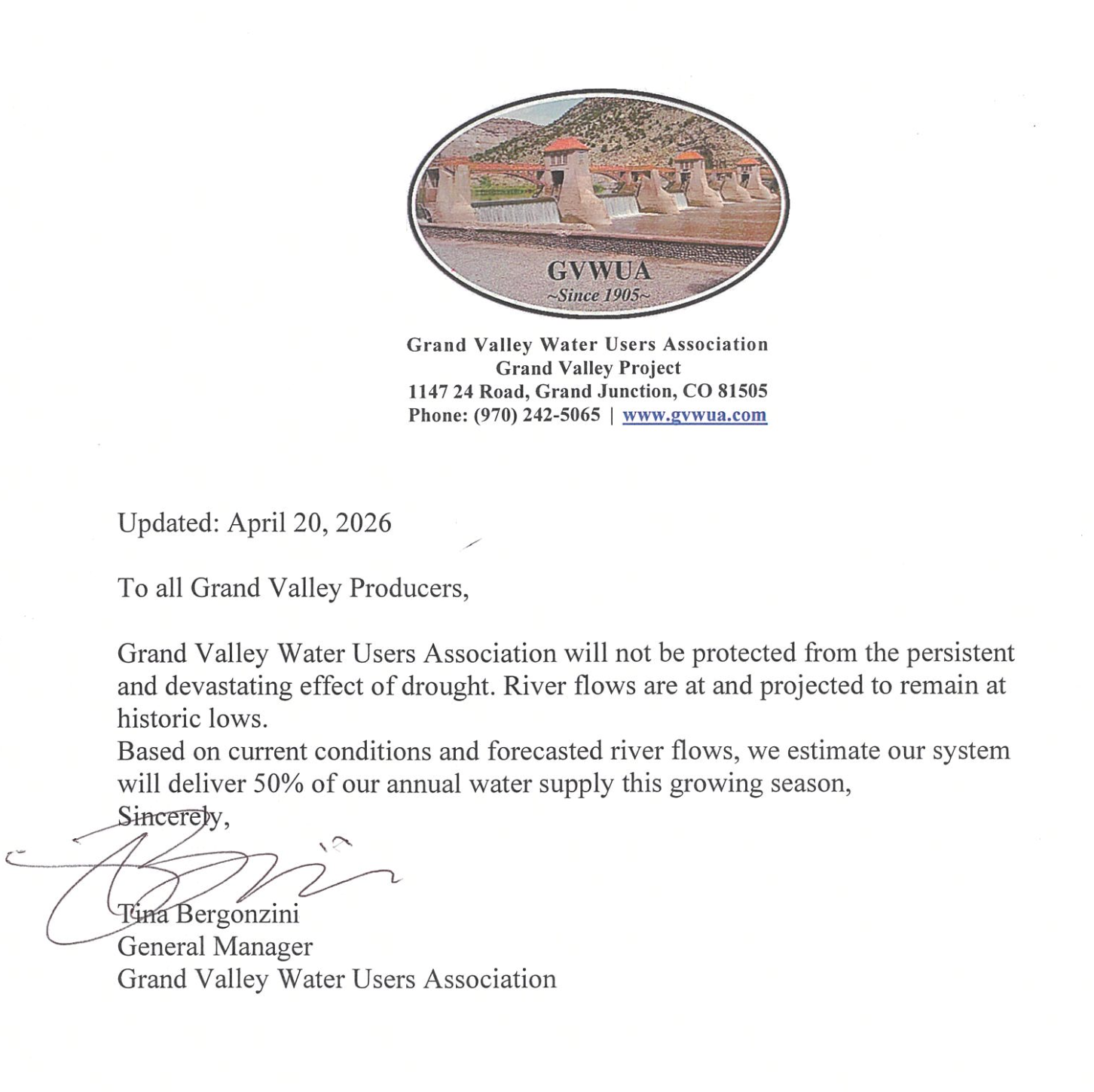
GVWUA User Info
Press Release Concerning Lower Basin Negotiations
*The Grand Valley Water Users Association stands firmly with our commissioner and our water users.*
The Colorado River is governed by law. By the 1922 Compact. By federal statutes and operating guidelines layered over more than a century. It is governed by infrastructure built to store, move, and deliver water across seven states under an agreed framework of rights and responsibilities that distributes water, risk and economic security.
That framework matters. The Colorado River Compact was not a suggestion; it is an executed contract. It divided the basin into Upper and Lower divisions and promised each an equitable apportionment of use. That agreement enabled the massive public works system that transformed the American Southwest, allowing cities to rise and irrigated agriculture to flourish and the Grand Valley to grow into the thriving community it is today. The legal foundation of this system is not who is largest or most politically influential, the foundation is a contract that allows each basin to develop its share of water as it sees fit.
This week, the Lower Basin governors released a joint statement regarding failure to reach a seven-state agreement by a February 14th deadline. Their statement emphasized the scale of their populations, economies, and agricultural output. But Compact apportions water equitably between geographic regions, not based on population, economic scale, or political influence. The Lower Basin’s statements seem to make an assumption that mismanaging this vital resource has somehow made them entitled to more of that same resource from Colorado while we have coveted, protected, and managed our water appropriately.
It was Colorado that first proposed the 1922 Compact, recognizing that only a binding agreement would allow our economies, our farms and our cities to prosper. And it is Colorado that finds itself defending that same agreement as the lower Basin governors call for “shared contribution” from all seven states.
When the Lower Basin states call for collaboration and shared contribution, they are asking Colorado to move beyond the Compact’s allocation framework, to absorb economic risk and uncertainty that would constrain our ability to farm, to grow our economies, and to use the water apportioned to the Upper Basin, of which only 60 percent has been developed.
Fortunately, Colorado’s lead negotiator is the bulldog we need in this moment. Becky Mitchell understands what is at stake and has refused, under pressure from environmental groups, from other states, and even from a few within Colorado, to acquiesce to demands that will injure Colorado and the Grand Valley.
GVWUA has participated in past pilot projects exploring voluntary, temporary and compensated conservation and been willing participants in numerous water-saving endeavors. The determined and nimble producers in the Grand Valley understand the importance of conservation, living within what the river provides, and they acknowledge a drier and hotter climate will bring changes to their operations and to our communities. However, the Lower Basin states need to recognize these hydrologic realities and make the changes necessary to correct the system they have failed through chronic and continued overuse. GVWUA will not ask our producers to bear the burden of Lower Basin mismanagement and their continued denial of the realities in front of them.
When we are confident that true conservation efforts are being discussed; programs that support not only the Lower Basin producers, but the Upper Basin’s users as well, we will be ready to support our commissioner and be part of the real work of supporting our neighboring Lower Basin states while they fix what they have broken.
GVWUA Water Info
Why Water is the Backbone of America’s Food Supply
Samantha Barncastle was recently featured on the Fill Your Plate Now podcast to discuss the critical role water plays in sustaining agriculture across the West.
Drawing on more than 17 years in water law and her background as part of a multigenerational farming family, Sam explains why Western irrigated agriculture produces a significant share of the nation’s fruits, vegetables, nuts, and dairy – and why reliable water delivery is essential to keeping that system functioning.
The conversation highlights the growing challenges facing farmers and ranchers, including aging infrastructure, regulatory delays, litigation pressures, and broader economic headwinds. At the same time, it points to opportunities through innovation, from precision irrigation to new crop development and collaborative solutions.
This episode offers a clear look at how water policy connects directly to food security, rural economies, and the long-term resilience of communities across the 17 Western states.
Why the West’s Irrigated Farms Are Critical to America’s Food Security, Episode 62 – YouTube
Zebra Mussels
Zebra Mussels and the Government Highline Canal
As we respond to this new threat, we appreciate our water user’s diligence and willingness to keep an eye out for anything that appears suspect to them. Zebra mussels can cause extensive and expensive damage to our system unlike anything we’ve deal with before.
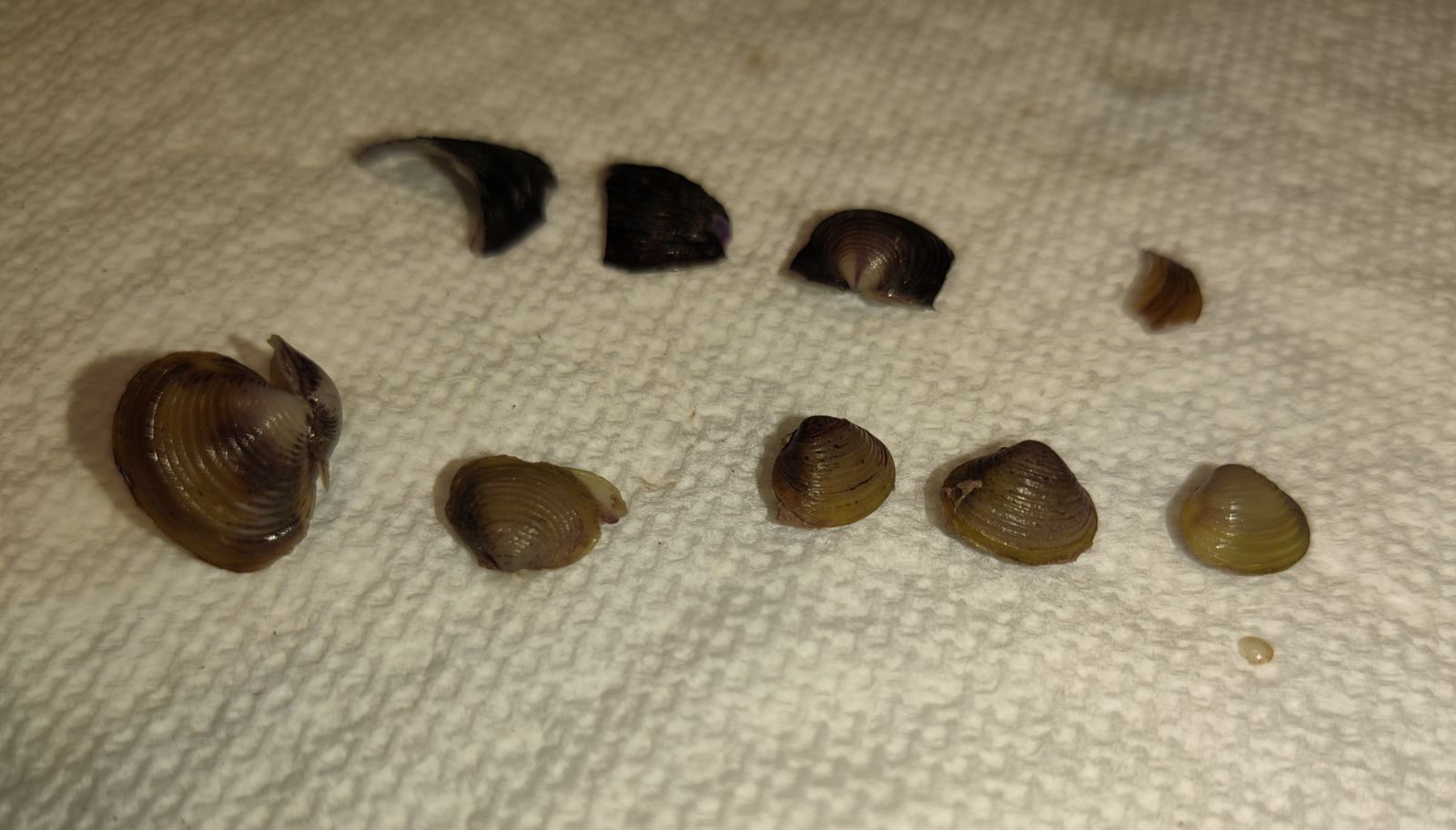
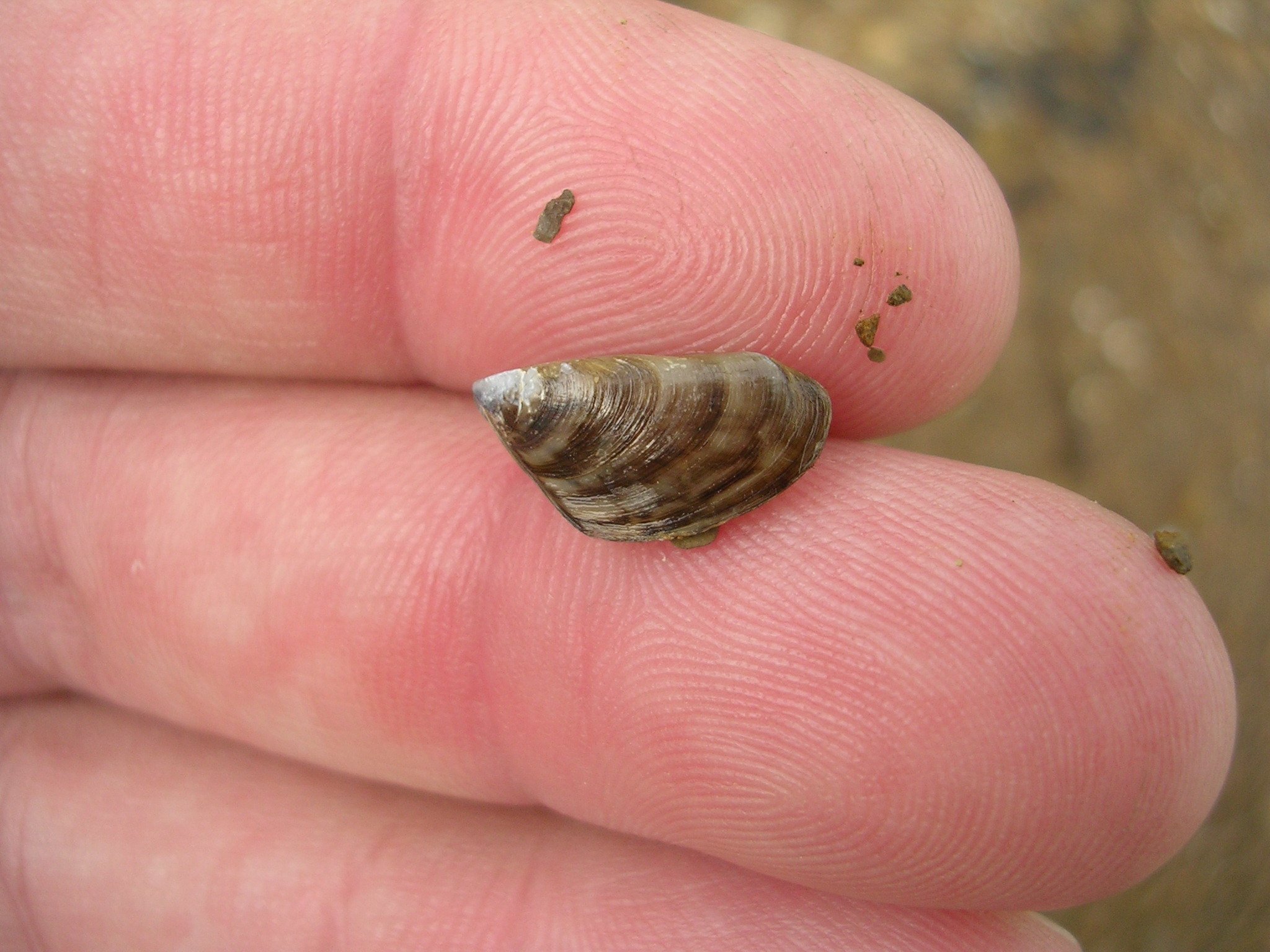
The picture taken on the paper towel are of native Corbicula clams not zebra mussels. The picture of the mussel on the person’s hand are zebra mussels and the pest we need you to watch for!
We would rather you send us pictures of native, non-harmful species and risk being wrong then send no pictures at all!
Never hesitate to reach out to our office staff at info@gvwua.com or your ditch rider with questions or concerns.
Zebra Mussels Helpful Links
Contact Your Ditch Rider
* Your Ditch Rider is your first point of contact for any irrigation water issues
Ride #1 – 28 ½ Rd to 24 ½ Rd / Lateral 0 to 14 – Tom: 970-242-6438
Ride #2 – 24 ½ Rd to 19 Rd / Lateral 15 to 33.5 – Jacob: 970-858-7519
Ride #3 – 19 Rd to 13 Rd / Lateral 34 to 46.5 – Mike: 970-858-7374
Ride #4 – 13 Rd to 6 Rd / Lateral 47 to 57 – Jeff: 970-858-7236
H2Order
Online water request tool for GVWUA Irrigation Customers
*** PLEASE PLACE ORDERS TWO DAYS IN ADVANCE ***
– With H2Order, customers can order irrigation water online
– Enter meter readings and flow rate changes using your phone, tablet and other devices
– Receive H2Order confirmations by e-mail (or text via cell number)
– Track water usage with data in your confirmation emails
– Give it a try today
Order Now
Important Info
Online Payments Now Available
– Online payment options are now available. The Pay Now button is at the top right corner of this Home page, or use the link below.
– Please Note: Convenience fees apply.
– GVWUA will continue to accept mail in checks, and in person payments. All credit card transactions will include convenience fees.
Assessments
Please note – unpaid Assessments are past due as of January 31st. 1% interest accrues monthly.
Accounts not paid are subject to being locked from water access.
Liens will also be filed on unpaid accounts in June. A $250 Lien Release fee applies.
Assessment Rate Classification
GVWUA’s Assessments are based on irrigable acres or “Class 1 Acres” as determined by the Bureau of Reclamation. Assessment rates are then classified by the number of Class 1 Acres and the land use. Land that has been Developed but left in the Agricultural Classification is being moved to the Developed Assessment rate.
Assessments must be paid prior to the beginning of the irrigation season to receive water.
Development Service Fees
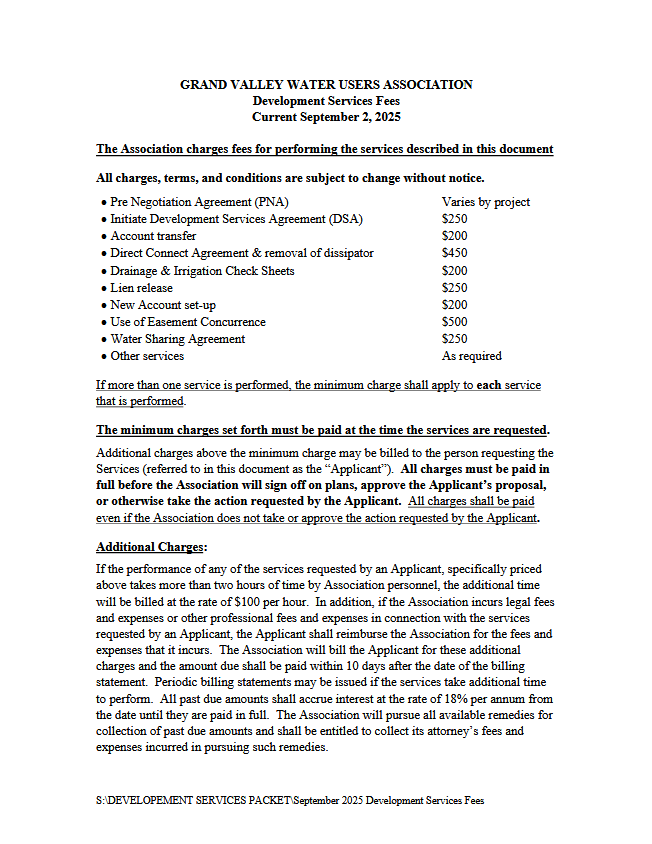
New User Access Fee
Learn more about our new user access fees.